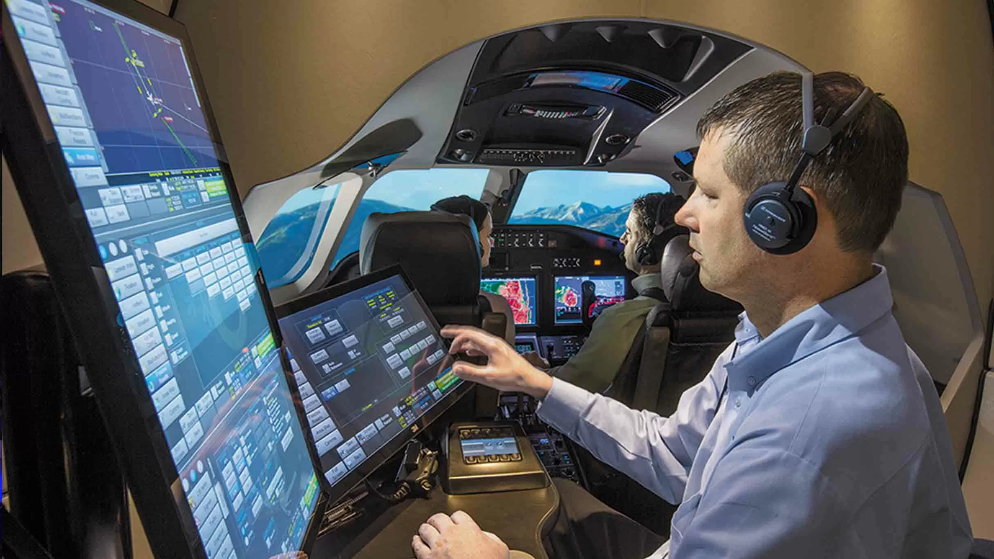
From Rote to Correlation: AI and Data Analysis for Human Intelligence
“We’re really looking at how we use data and AI to really improve the human intelligence experience,” stated Mark Kleinhans, Director of Safety for Flightsafety International (FSI).
“There’s an application of artificial intelligence – that I’m not sure is fully thought out – which is where machine learning could tell a pilot in training specifically what they did wrong to pass a specific maneuver. We could say you were off heading 20 degrees because you didn’t put in enough right rudder; you needed 10 more pounds of right rudder. There’s a use case for initial basic training, maybe the first day or two of a simulator session, to help somebody adapt to the airplane a little more quickly.”
“But we see a larger use, and that is to use AI as a tool to improve human intelligence. What we’re looking for in the data is how can we get a pilot that knows how to fly an airplane to recognize the risk factors that are building up and to mitigate them in real time, and have that sort of human intelligence and knowledge to be able to do that. So that’s really where we’re focusing our data and why we’ve partnered with GE and why it’s not just to get somebody through a check ride an hour faster. We want to make much more capable and much safer pilots out there in roughly the same amount of training time.”
“If we can compress training time, it would only be to create space in the current footprint to do more advanced things. Meaning if we can get them more proficient or proficient earlier in the footprint that we have today, that frees up space to do more application and correlation of those skills versus just rote memorization for the check. We’ve got to move more things from rote to correlation.”
THE CORPORATE-FOQA INITIATIVE
“If you’re not measuring it, you’re not going to know how are we trending over time. How are things changing? How can how can we improve here?” said Luke Bowman of GE Digital Aviation Software. “You may have people who are saying, I think that’s the problem over there. But you’ve got to have the data to back up that sort of decision making. Data without action is a liability. If we don’t actually take action on that data, it’s a liability to all of us. We could have prevented something if we had better utilized that data. Action without direction has risks.”
GE Digital and FSI created a partnership in 2021 to enable the longtime business aviation training company to access GE’s trove of C-FOQA data.
C-FOQA is the corporate corollary to airline Flight Operations Quality Assurance (FOQA), aka flight data monitoring (FDM). GE created the concept in 2015 in partnership with the Flight Safety Foundation (FSF) independent research organization. GE’s patented analytics software fuses meteorological information, navigation data, and terrain mapping to identify safety events and measurements on thousands of flights every day. More than 300 operators and 1,000+ aircraft are part of the C-FOQA community.
“When I was with my previous employer [NetJets],” explained D. Richard Meikle, FSI Executive Vice President, Operations and Safety, “we stood up a program, and GE made the most sense to us. They were certainly the most respected provider we could come across. They are well utilized by all of the major airlines in the United States.”
“They have the experience there. And then they had that C-FOQA data. And, of course, with our focus on the business aviation side, that C-FOQA piece was the gap to provides us direction. A logical pair up. We went to GE in 2021 and said, we’d like to be consumers of your data.”
“They truly are a partner. It’s not a vendor-customer relationship type thing. They’re providing the data analytics without necessarily the influence to be able to go and affect change directly. We have the ability to, in effect, change directly. But we needed the data.”
GE, of course, a major aircraft engine OEM, had long been monitoring data on the performance of aircraft systems on behalf of operators and maintenance providers through programs such as their Configuration Data Exchange (CDE).
One of their byproducts is FlightPulse, an app that provides pilots with secure access to flight data from their own individual flight history so they can ‘self-discover’ areas to optimize operations such as emission reduction. Bowman said, “FlightPulse was designed by pilots, for pilots, to empower them with the data they need to make smarter decisions around safety and fuel consumption.”
The data partnership with GE “sort of opened our eyes as to the actual operation of the airplane in the real world,” said Meikle. “Without that, there’s a risk that you head in the wrong direction where you focus on the wrong things.”
In addition to GE-FSF’s C-FOQA data, Meikle said Flightsafety has added flight-related events and maintenance service reports from multiple sources to enhance insight into business aviation and regional airline trends.
Self-described ‘safety nerd’ Bowman recalled, “We started in FDM 25 years ago… been doing this for a long time. One of the things that we always thought would be just a cool problem to work on is taking data off simulators and being able to analyze that data in the same way that you analyze flight data coming off an aircraft.”
SYNCHING AIRCRAFT OPS and SIMULATOR DATA
“There’s training and then there’s real world, and they should really overlap. You know, train the way you fly and fly the way you train. If you’re not able to measure how you’re training as effectively as you are measuring the way you fly the airplane, it’s difficult to make that comparison.”
Matching up data from aircraft operations and data from flight simulators used for training – always a holy grail of the training industry – is not a simple task of aligning Column A with Column B.
“Actual data extraction is not particularly difficult,” explained FSI’s Kleinhans. “But what is surprisingly difficult is these aren’t operating in the real world. We can create whatever weather we want or whatever temperature we want or whatever flight conditions we want. So that adds a level of complexity. Additionally, the simulator operates in abnormal conditions non-stop, whereas normal flight operations are normal or relatively normal. So we don’t spend a lot of time with both engines running or without a fire on the airplane, or without an electrical problem. We have to account for that in the analytics; we have to know what condition the aircraft was flying under.”
“The hard part is, what are the appropriate parameters that the flight crew should be operating within during these conditions, and how do we measure that? How do we compare that to baseline data when that data doesn’t exist in the real world?
“An airplane’s data stream is continuous. They start the engines, taxi out, takeoff, fly, cruise, descend, land, taxi and shut the engines off. The simulator data may start like that. And then you get to 3000 feet and we stop, freeze, reposition. And now, all of a sudden, the airplane goes from eight miles away from the airport at 3000 feet to back on the ground. And that data stream will look very different to the analytics tool. One of the hurdles that the team had to account for is slowing, repositioning, freezing – all the things that an airplane would never do.
“We’re in abnormal operations all the time,” he concluded.
Another disconnect between real-world aircraft data and virtual full-flight simulator data is the variations among individual FFSs. “If you pull an airplane off the production line and then you pull the next 10 airplanes downstream, the parameters and the way it’s all encoded onto the flight data recorder are identical,” said Kleinhans. “That’s not true in simulators. You might have two simulators that are built back-to-back, but maybe because they were six months apart there was a new computer or some new component that was released between the two. So it won’t necessarily look exactly the same.
“We’ve got to do that conversion to make them all look the same, so when the data’s consumed it fits.”
“What we can do is take our data and essentially analyze it in the same way that you would analyze a real aircraft in the same set of conditions. That lets us see the difference between how flights are operated in the real world versus how they’re operated in training, to see if there are differences there. That gives us some insight into a change in behavior of pilots when they’re in the training environment versus the real-world environment.”
“But it’s actually a little more than that. It also allows us to compare the tasks that we’re training to the real-world risks.
“Our job as a training provider is to try to build better pilots. And we want them to not just pass check rides as fast as possible, we want them to actually be capable pilots out in the real world, experiencing real-world conditions, not just the tasks that are required by regulators around the world. We need to understand where those risks are, and that’s where the data from C-FOQA comes in. We can take that and build similar conditions and scenarios in our training environment and compare the performance and try to improve the performance with that lens. It’s not just the simulator export of the data, it’s the real-world data actually inflowing into our training to try to improve the actual efficacy of the training itself.”
To read the complete FSI / GE chapter, order The Robot in the Simulator – available in paperback book or PDF – NEW BOOK – AI in Aviation Training – AVIATION VOICES