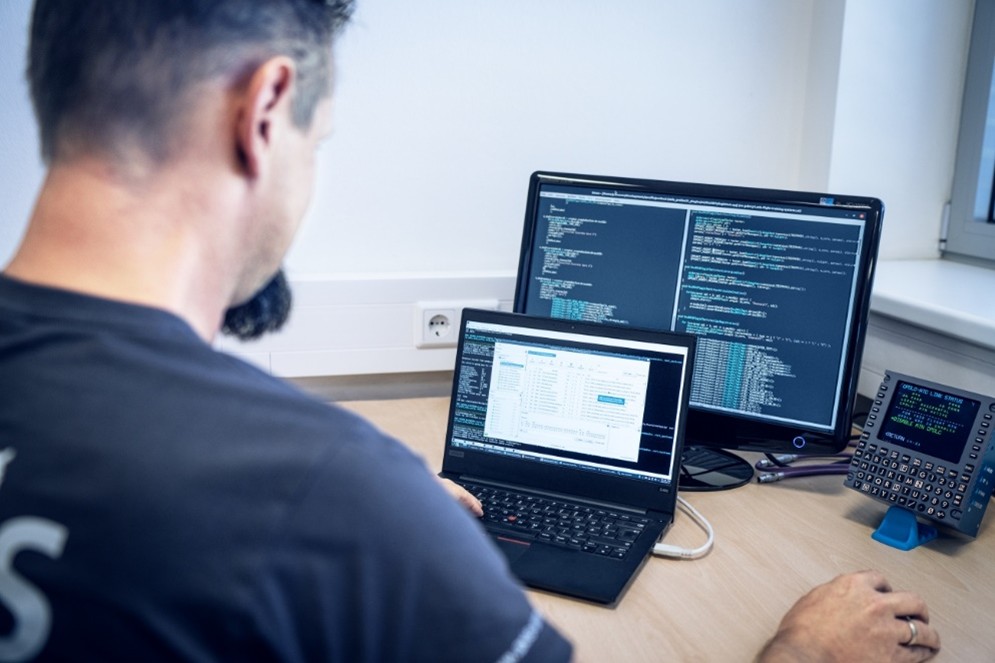
AI Instant Debrief Station
ATR regional aircraft and business aircraft full-flight simulator company AXIS Flight Training Systems GmbH (Lebring, Austria) are developing an artificial intelligence-supported ‘instant debriefing’ station. The initial concept is to aide the instructor with additional, objective data. But they have a “crazy idea,” according to CEO Christian Theuermann, to eventually “support training devices without an instructor so the pilot can do this on their own,” ostensibly on lower-level devices, “and get automated feedback.”
“We will do it [incorporate AI] step by step,” Theuermann explained. “We are working on an AI-driven debriefing station which is totally different to the existing debrief station where you are sitting in a room. It runs on an iPad or any mobile device, and the debriefing could be done immediately. In the cockpit, if required.
“It supports the instructor-based technology.” Axis has an automated feedback system so the debriefing “is not only driven by the instructor, based on his knowledge of what he saw during the session, it is driven on an objective debriefing… including evidence-based training. Our approach is to give the instruction an overview.”
“It will reduce debriefing time. It creates an automated report – there is no need to write reports at the end, so it will reduce instructor time.”
A device fitted to a company simulator will “collect data, data, data from every session. It’s learning, learning, learning. As more trainees are using the system, it’s getting better and better,” said Theuermann.
Data protection? “If the trainee or the training center is not motivated to do so, they only need to disconnect the simulator from the internet. If the customer is motivated, they connect to the internet, then all this data will be submitted to our AI algorithm running tool.”
“If there is maybe a fear that the airline or the operator can figure out the best or weakest pilot, it’s not possible with our data for the instructor or the end client to see the name of the pilot. We are really protecting the data because, otherwise, no one would use this technology, I think.”
In addition to FFSs, the data collection tool can be used on lower-level flight training devices. “Doesn’t matter, it collects data. You only need to define the syllabus. And then you define what kind of data we are collecting based on the training syllabus,” Theuermann noted.
Axis is working with Amazon Web Services (AWS) to store the data in the Cloud.
“You can cluster it if you want,” Theuermann added. “You could also use it for gamification. I believe gamification will come into training with all these new technologies – VR, mixed reality… because the newer generation of pilots, the young pilots, are aware of these technologies.”
“We are really starting to dive deep in this topic. We are working with companies in strategic partnership when it comes to mixed and virtual reality.”
“Our idea is to offer clients different levels of training solutions, besides full-flight simulators. Start from, let’s say, a walkaround trainer for ATR or business jets, virtual cockpit trainer, procedures trainer, flat panel trainer… There is no need to train procedures in an FFS; you can do this with virtual reality, very easy.”
The AXIS goal is to bring the combination of technologies to the market within a year or two.
One capability of AXIS that comes into play is collecting aerodynamic flight data from aircraft, which is then used to develop their simulators (when the data is not otherwise available from the aircraft manufacturer). “We are a bit more flexible because we are collecting data to build simulators,” said Theuermann, “and optimize training with this collected data. We can fly special manuevers and then we have the real aircraft data. I think this will support this approach.” AXIS has qualified more than 50 full-flight simulators around the world across its 20-year history. “We are focusing on regional aircraft types, turboprop like ATR, and business jets.”