Impact of EBT/CBTA on Training
And How It Fuels APC’s Adaptive Learning Plan
Executive takeaways
* EBT/CBTA shifts training from checking boxes to building transferable competencies, using operational evidence and continuous measurement.
* EASA and ICAO have codified EBT/CBTA, enabling operators to redesign syllabi, instructor standards, and data flows around competencies—exactly the scaffolding our framework needs.
* Evidence to date shows improved training relevance, better resilience to unexpected events, and higher training system efficiency when programs adopt EBT with robust data practices.
What EBT/CBTA changes (and why it matters for us)
1) From task lists to competency outcomes
CBTA defines training around performance outcomes and observable behaviours (OBs), with continuous monitoring baked in. EBT prioritizes training topics using operational evidence, then clusters scenarios by risk relevance and aircraft generation—driving smarter repetitions and scenario design.
2) Instructor calibration becomes a first-class requirement
EBT places explicit emphasis on instructor competencies and calibration standards. This underpins our Instructor Alignment Score (IAS) and iORCA calibration loops.
3) Data as the engine of continuous improvement
EBT requires structured collection/analysis of training data, which maps neatly to Amelia/ORCA’s OB granularity and our algorithmic roadmap.
Documented impacts you can expect
| Impact area | What EBT/CBTA changes | Why it helps our KPIs |
| Safety & resilience | Focus on competencies applicable across scenarios; evidence-led scenario set | Higher CPI, better Scenario Success Rate; improved handling of the unexpected |
| Training efficiency | Replace low-yield maneuvers with high-risk, high-relevance scenario clusters; adaptive repetition | Better TER and lower TTC |
| Instructor standardization | Defined instructor competencies + calibration methods | Reduced variance → higher IAS and fairer assessments |
| System-level governance | EASA oversight tools & checklists for mixed/baseline EBT programs | Faster approvals; consistent implementation across ATOs/airlines |
| Evidence of effectiveness | Studies & airline datasets show performance gains and clearer link between grading and outcomes | Supports our Value-Added Metric and ROI claims |
How to plug EBT/CBTA into our adaptive learning framework
A) KPIs (from our plan); EBT signals
CPI / Competency Trajectory Slope – ICAO/EASA competency set with OB counts & quality.
TTC / Adaptation Speed – EBT-driven scenario sequencing and recovery tracking.
TER – EBT evidence table guides removal of low-yield items; track gain/hour after syllabus edits.
IAS – EBT instructor competency model and calibration guidance.
B) Data we must capture (aligned to EBT/CBTA)
Per-exercise OBs with time stamps, scenario tags (threats, automation profile), aircraft gen cluster.
Instructor grading metadata (rater ID, calibration band, variance to AI/instructor group).
Evidence sources used to justify syllabus to audit improvements.
C) Actions (EBT-style) that move the needle
Re-weight scenario mix by current risk picture each cycle.
Introduce competency boosters when early predictors flag risk.
Calibrate instructors quarterly using variance dashboards and targeted co-observations.
D) Algorithms that benefit from EBT/CBTA structure
CPP (progress predictor) trained on OB-level trends.
EWD (early warning detector) using scenario-cluster outcomes tied to evidence tables.
ALR (lesson recommender) constrained by EBT competence map.
IBA (bias adjuster) leveraging instructor competency standards to normalize grading.
EASA vs FAA implementation notes
EASA: Fully codified pathways for baseline/mixed/advanced EBT, with oversight toolkits and competency catalogs.
FAA: No direct ‘EBT’ rule, but CBTA principles are widely compatible (AQP, ATP-CTP, operator-specific CRM/TEM).
Measurement strategy (to prove value)
1) Baseline cohort: run current syllabus; capture CPI/TTC/TER/IAS + remedial rates.
2) EBT/CBTA cohort: implement evidence-led scenario mix, calibration program, and adaptive micro-interventions.
3) Compare deltas: CPI, TER, TTC, remedials, IAS variance.
Practical next steps (6–8 weeks)
Discovery/Exploration: Map our current lesson/exercise library to EASA EBT competencies & OBs.
Development: Stand up dashboards for CPI/TTC/TER/IAS; implement instructor variance views.
Testing: Run toy data simulations.
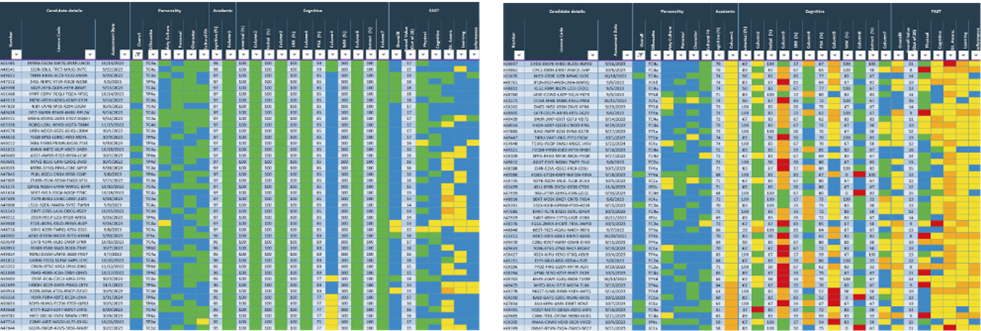
Demo package: Heatmaps, trajectory plots, instructor calibration report.
Key references
ICAO Doc 9995 — Manual of Evidence-Based Training
ICAO Doc 9868 (PANS-TRG) — CBTA & instructor competency framework
IATA EBT Implementation Guide & Data Report
EASA EBT rule set & oversight tools
Empirical studies/reviews on EBT performance